

An Umrah transport receipt proves that a payment was made. It does not, on its own, prove that the journey is booked, and it does not tell the driver or your relatives where and when the pickup happens. For that you need two further records alongside the Umrah transport receipt: the booking status reading Confirmed, and the journey details that go with it. Keep all three, but use each one for the question it actually answers.
This guide is for the family member who pays for the airport transfers and hotel journeys, often from home, and then gets asked for “the receipt” by an insurer, an employer, a mosque committee or a sibling who is sharing the cost. It explains what each record shows on a Pilgrim Taxi booking, why the payment and the confirmation arrive at different times, what to do about money paid in cash on the day, how to prepare records for a travel insurance claim or a reimbursement, and how to keep one clear set of evidence after a change.
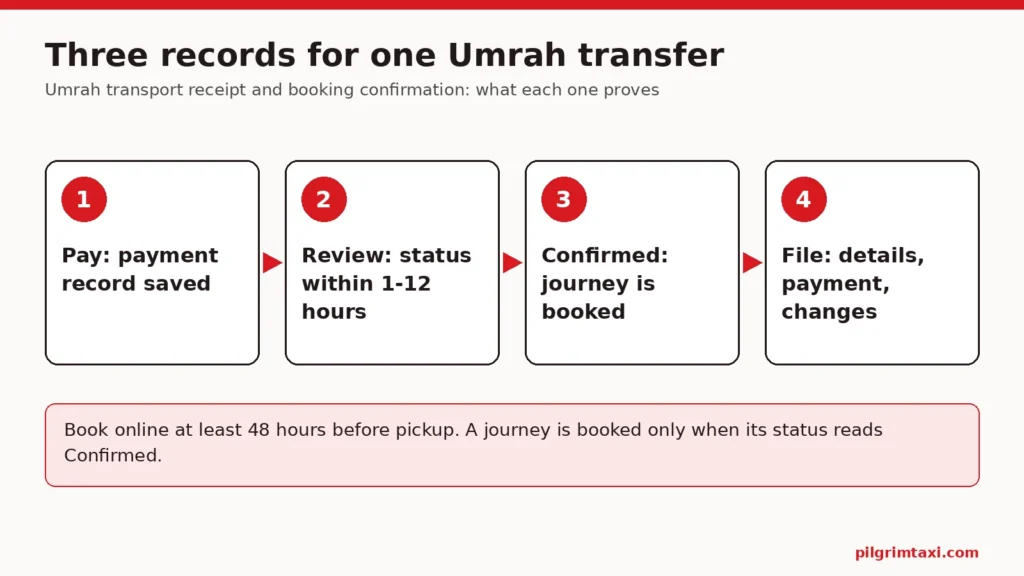
Three records, three different questions
Most confusion comes from treating every email and screenshot as the same kind of document. It helps to name them separately and to ask what each one can prove.
| Record | What it proves | What it does not prove | Where to find it |
|---|---|---|---|
| Payment record | That money was taken, how much, in which currency, on what date | That a vehicle has been allocated, or that the journey details are right | Your account’s payment details and your card statement |
| Confirmed status | That the booking team has accepted the journey and it is booked | The amount paid, or any cash due on the day | The status timeline in your account |
| Journey details | Pickup place, destination, date and time, passengers, luggage, vehicle class, stops | That payment has cleared or that the status is Confirmed | The booking in your account |
The first record belongs to whoever paid. The second and third belong to everyone in the trip, because they describe what will happen on the road.
What an Umrah transport receipt actually proves
On Pilgrim Taxi, the whole price of each journey is paid online at checkout. The amount appears in your chosen display currency, one of 13 on offer, including pounds, riyals, euros and US dollars. Your card issuer then records the charge in its own way, which may show a converted amount if the card is in a different currency from the one you chose. Treat both as part of the same payment record, and keep them together.
A payment record is strong evidence for questions about money: how much was paid, when, and by whom. That is exactly what an insurer, an employer or a relative splitting the cost will want to see. It is weak evidence for questions about the journey itself. A figure and a transaction reference do not tell anyone which hotel the car is going to, or which flight it is meeting.
There is also a practical limit. Paying secures a provisional request; it does not book the journey. An Umrah transport receipt shows that you paid for a request, not that the journey was accepted. The Confirmed status is the record that proves a booking.
What the Confirmed status proves
After payment, the booking team reviews the journey and updates the status, usually within 1 to 12 hours. The journey is booked only when the status reads Confirmed. Before that it is a paid request that has not yet been accepted.
That word matters more than any email subject line. A family member who sees “payment successful” and tells the rest of the group that everything is sorted has reported the wrong event. Our note on using four clear words for your travel status suggests a simple vocabulary for relatives, so that “paid” and “confirmed” never get merged in the family conversation.
If the booking team cannot supply the journey, or we or the transport partner cancel it, and no suitable alternative is accepted, the customer receives a full refund for the affected journey. In that case the payment record and the cancellation notice together become the evidence that the money came back, and there is nothing to claim elsewhere for that journey.
Journey details: the record the traveller actually uses
The third record is the one that gets people to the right car. It lists the pickup place and destination, the date and time in Saudi local time, the number of adults, children and infants, the large bags and cabin bags, the vehicle class, any stops in journey order, and any child seats or wheelchair requirement confirmed for the vehicle. For airport journeys it includes the flight number given at checkout. Once a driver is assigned, the driver’s name appears in the account as well.
The lead traveller needs this record far more than the receipt: which hotel, what time, which flight. None of that is on a card statement.
This is why it pays to separate what you forward. The journey details can go to the travelling party. The payment record usually does not need to, and forwarding it widely spreads information about your card and account that nobody in the car needs.
Booking confirmation vs payment receipt: why they arrive at different times
The gap between paying and confirmation is deliberate. A website can take a payment in seconds, but a person has to check that the journey can be supplied as searched: the vehicle class, the date and time, the pickup and destination, and any child seats or wheelchair requirement.
So the order of events on a normal booking is:
- You search, choose a vehicle class and pay. A payment record exists and the booking is a provisional request.
- The booking team reviews the journey, usually within 1 to 12 hours.
- The status changes to Confirmed. Only now is the journey booked.
- Later, a driver is assigned and their name appears in the account.
The practical difference between a booking confirmation vs payment receipt is simple: one is about the journey being accepted, the other is about money leaving your account. If an email or notification arrives twice, or the wording confuses you, check the status in your account rather than guessing. Our guide to a confirmation email that arrived twice walks through that situation without creating a duplicate booking.
Cash paid on the day: the part no online payment record shows
Pilgrim Taxi takes the journey price in full online, so for most bookings there is nothing further to pay. There is one common exception. If you ask for a new pickup time and the booking team approves it, a £5 rescheduling fee applies, converted into the booking currency (about SAR 25 when the booking is in riyals). That fee is added to the cash paid to the driver at pickup. HQ may waive it, and a rejected request costs nothing.
That cash does not appear on the original payment record, because it was never charged to the card. The account shows the cash due to the driver, so the evidence that the amount was due sits there. Whether a separate written receipt can be given for cash handed over on the day is something to ask the booking team about in advance, rather than assuming.
If an employer or insurer may be involved, note the amount, the date and the reason for the new time as soon as the request is approved.
Using a transfer receipt for travel insurance
Travel insurance is the most common reason families go looking for their transport records after the trip. Whether a policy covers a prepaid airport transfer at all depends entirely on its wording, so start there. The UK government’s guidance on foreign travel insurance advises reading the small print and understanding the exclusion clauses before you rely on a policy, and checking that it covers all the places you intend to visit and the full length of the trip.
When you do make a claim, the insurer will want evidence. MoneyHelper, the government-backed money guidance service, says in its guidance on cancelled or delayed holidays that companies expect receipts as proof for claims, and that you are expected to have tried to get a refund from the travel firm before claiming on insurance.
For a transfer receipt for travel insurance purposes, that points to a sensible bundle:
- The payment record for the journey, showing the amount, currency and date.
- The journey details, so the insurer can see what the payment was for and match it to the trip dates.
- The status history, showing whether the journey was confirmed.
- The reason the journey was not used, in your own words and with any supporting evidence, such as an airline’s cancellation notice or a medical note.
- Any reply from the booking team to a cancellation or refund request.
When you cancel and when we cancel
These two situations produce different paperwork, and it helps to know which one you are in before you contact anyone.
If the customer cancels, the booking is subject to our cancellation terms (free cancellation with a full refund up to 48 hours before pickup; inside 48 hours the deposit element of the price is kept). You can still submit a cancellation request from your account, with a reason, and it is worth doing so, because the response is part of the record an insurer may ask to see. Whether your policy then pays anything towards the lost cost is a matter between you and the insurer.
If we or the transport partner cancel, or cannot supply the journey and no suitable alternative is accepted, you receive a full refund for the affected journey. There is then no transport loss to claim, and saying so plainly on any claim form avoids confusion. The full wording is in the cancellation and refund policy.
Employer, charity or committee reimbursement
Some Umrah trips are paid for or subsidised by someone other than the traveller: a company supporting a member of staff, a charity sponsoring an elderly pilgrim, or a mosque committee organising a group. Each will have its own rules about what counts as evidence, and those rules decide what you should keep.
Ask before you travel, not afterwards. A short question such as “Do you need the payment record, the journey details, or both, and in which currency?” saves a lot of back and forth later.
For UK employers, the government’s guidance on record keeping for expenses and benefits says employers must keep the date and details of every expense or benefit they provide, and keep those records for three years from the end of the tax year they relate to. Whether a particular payment is an expense or a benefit is for the employer and their adviser to decide, not the traveller, but it explains why a finance department may ask for more detail than a family member would.
If several journeys were paid in one checkout, make sure each is identifiable, because a reimbursement may cover the airport transfer but not a hotel move.
Splitting the cost across the family
When siblings or cousins share the cost of transport for their parents, the receipt question becomes a family question. A few habits keep it calm.
First, remember that each price is for the vehicle doing that journey, not per person. Dividing by heads is a private family decision, and it belongs in a separate note rather than being written onto the booking record. Our guide to reading an Umrah taxi price per vehicle rather than per person explains why the vehicle class, not the headcount, sets the figure.
Second, avoid sharing the account password to “prove” a payment. If a relative needs to check the journey before anyone pays, the basket can email a secure review link, so one person can review and another can pay. After payment, a screenshot of the relevant journey and amount is usually enough for the family.
Third, keep the currency consistent in the family note. If you paid in pounds and a sibling thinks in riyals, write the paid amount and currency exactly as charged, and do any conversion separately with the date, so nobody later argues over a figure that was never on the record.
Worked example: the Qureshi family’s three records
Imran Qureshi lives in Leeds and is paying for his parents’ Umrah transport. His sister Nadia in Manchester has agreed to pay half. His father’s employer, a small company, has offered to reimburse the airport transfers only, as a retirement gift. The parents also have a travel insurance policy bought by Imran.
Imran books three journeys: Jeddah Airport to a Makkah hotel, the Makkah hotel to a Madinah hotel, and Madinah hotel to Madinah Airport for the flight home. He pays in pounds at checkout. Within a few hours the status on each journey reads Confirmed.
He then builds three small folders.
For the family: the journey details for all three journeys, which he sends to his parents and Nadia, and a one-line note of the total and Nadia’s half. He does not send his card statement.
For the employer: the payment records and journey details for the two airport journeys only, clearly labelled, because the Makkah to Madinah journey is not covered. He asks the company in advance whether it needs the amounts in pounds, and it does.
For the insurer, if ever needed: all three payment records, the journey details, and the status timeline, stored together with the policy document.
Ten days before travel, his parents’ return flight moves by three hours. Imran requests a new pickup time for the Madinah Airport journey from his account. The booking team approves it, and the account now shows a £5 rescheduling fee, converted into the booking currency, added to the cash due to the driver. Imran adds a line to the employer folder recording the change and the amount, and asks the booking team whether a receipt can be given for the cash. The new pickup time replaces the old one in the family folder, and he deletes the older screenshot from the parents’ phone so there is only one current version.
When the employer asked for evidence two months later, Imran sent it in a few minutes.
After a change: which version is current
A change creates a new version of the journey, and an old screenshot can easily outlive it. Only the pickup time can be changed online. Place, destination, passengers and vehicle cannot; changing those needs the booking team, or a new booking plus a cancellation request on the old one. Each of those routes leaves its own records, and the payment for a new booking is a separate payment.
When something changes:
- Treat the account as the single source of the current journey details.
- Label any older copies as superseded rather than leaving them mixed in with the current ones.
- Send the travelling party one replacement summary rather than a correction to an earlier message.
- Keep the payment records for both the original and any replacement booking, because together they explain what was spent.
If you are changing one journey in a multi-journey trip, our guide to changing one journey without changing the rest shows how to keep the other journeys’ records untouched.
Where to keep the records during and after the trip
During the trip, the lead traveller needs the journey details on their phone and, ideally, on paper as well. Payment records can stay with the organiser at home. Our note on keeping an offline copy of the essential journey details covers what to print and what to save for a phone with no data.
After the trip, keep the full set together until any claim or reimbursement is settled, and for as long as the organisation paying asks you to. A simple folder structure works well: one folder per journey, each containing the payment record, the journey details as confirmed, any change or cancellation request and its reply, and any note about cash paid on the day.
Name files so a stranger could understand them, such as “Jeddah Airport to Makkah hotel, confirmed” rather than “screenshot 14”.
Checklist: your Umrah transport receipt and other records
- After paying, save the payment record for each journey, including the amount and currency charged.
- Wait for the status to read Confirmed before telling anyone the journey is booked.
- Save the confirmed journey details for each journey separately.
- Send the journey details, not the payment record, to the travelling party.
- Ask any employer, charity or committee in advance what evidence and currency they need.
- Check your travel insurance wording for what it covers before relying on it.
- If you request a new pickup time and it is approved, note the £5 rescheduling fee added to the cash paid to the driver.
- Ask in advance whether a receipt can be provided for any cash paid on the day.
- If you cancel, submit the request with a reason from your account and keep the reply.
- After any change, mark older copies as superseded and keep one current version.
- Keep all records together until any claim or reimbursement is fully settled.
When your family’s travel dates, flights and hotels are settled, use the Pilgrim Taxi ride finder to search each journey, check the vehicle class and price, and start the records you will keep from payment through to the final Confirmed status.