

Umrah with friends on separate transport works well when both groups treat their bookings as two independent arrangements and share one simple plan: who lands when, which hotel each group goes to, where you will meet, and who waits for whom. Your Pilgrim Taxi journey carries only the people and bags you counted into it, and the other company’s journey carries only theirs. Neither driver is responsible for the other group, and neither booking waits for the other unless that has been agreed in writing with the company concerned.
This guide is for the organiser who has booked a family’s transfers with Pilgrim Taxi while friends, neighbours or relatives travelling on the same dates have booked with another transport company, or through their travel agent’s package. It covers what each booking can and cannot do, how to write a shared plan both groups can follow, arrival-day decisions about waiting, meeting points at airports and hotels, what happens if someone wants to switch vehicles, and what to do when one group’s plans change. A worked example and a checklist close the guide.
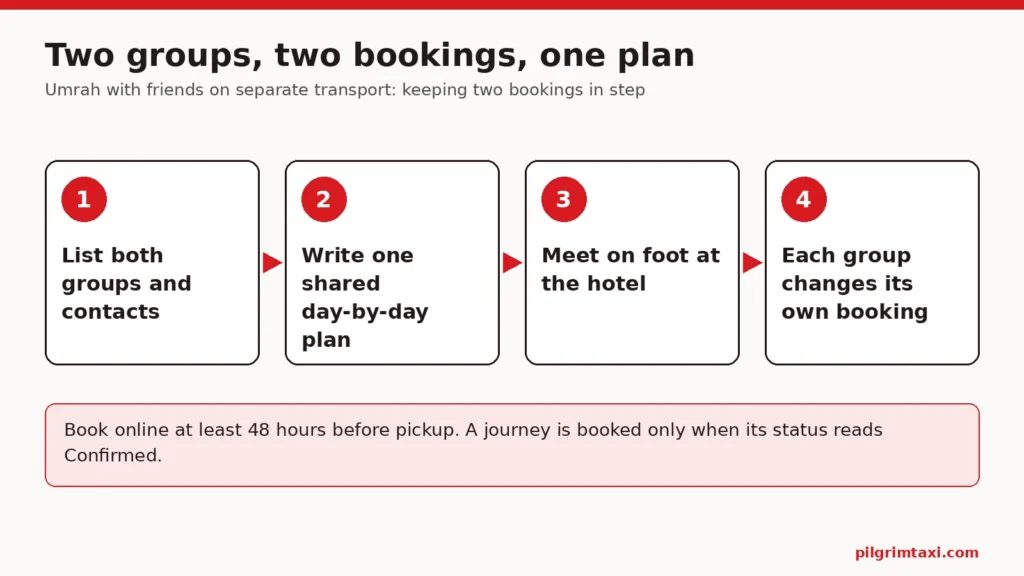
Why two bookings stay two bookings
A Pilgrim Taxi journey is defined by a small set of details: one pickup place, one destination, a pickup date and time in Saudi local time (UTC+3), and the passengers (adults, children and infants) and luggage (large bags and cabin bags) travelling. The vehicle classes shown in search results are the ones that pass a capacity check for exactly that party and those bags.
That definition is the reason friends cannot simply “share” a booking in an informal way. If your journey was searched for four adults and four large cases, the vehicle was chosen for four adults and four large cases. A fifth person from the other group, or their two suitcases, is not part of the arrangement, however well everyone knows each other.
The other company likewise has its own vehicle, driver, waiting rules and contact process, and neither group can rely on the other’s booking.
None of this stops friends travelling together. It only stops a friendship plan quietly becoming a transport promise nobody has agreed.
Umrah with friends on separate transport: what to share
The groups need to share enough information to coordinate, and no more. A useful rule is to share the plan, not the paperwork.
Each group should speak only to its own provider about its own booking, so references stay private.
Share:
- flight numbers and scheduled arrival times into Saudi Arabia, in Saudi local time;
- the arrival airport, and the terminal once the airline has confirmed it;
- the hotel each group is going to, with its full name;
- the pickup time each group has booked for later journeys, such as the move between Makkah and Madinah;
- the name and phone number of the travelling contact in each group.
Keep to yourselves:
- booking references and account logins;
- payment details, receipts and amounts paid;
- passport numbers and copies of documents;
- the other group’s driver details, unless their organiser chooses to pass them on.
For the contacts, one travelling person per group is usually enough. Our guide to one organiser and one travelling contact explains why the person at home and the person in the arrivals hall need to be different names on the list.
Coordinating two Umrah transport bookings with one shared plan
Coordinating two Umrah transport bookings is far easier when both groups work from one short written plan rather than a long chat thread. A single page, pinned in a shared chat or printed, is enough.
What goes in the shared plan
Set it out with one line per movement, recording:
- the date, in Saudi local time;
- what is happening (arrival, hotel move, departure, visit);
- group A’s transport: provider, pickup time, pickup place, destination;
- group B’s transport: provider, pickup time, pickup place, destination;
- where and when the groups intend to meet, if they do.
Who owns the plan
Choose one person to update the shared plan. When a flight time changes, that person edits the line and posts a short note saying what changed.
What the plan is not
The shared plan is a coordination tool. It is not a booking and it does not change anything with either provider. If your group’s time changes, you still need to request the change through your own account, and the other group needs to do the same with its own company.
Arrival day: who waits for whom?
This is the question that causes most friction between friends. The honest answer is that each group’s transfer should leave when its own party is ready, unless something different has been agreed with that group’s provider.
Pilgrim Taxi vehicle classes have an included waiting allowance, but it is not currently shown on search results, and it exists to cover the ordinary time it takes a party to come through the airport, not to hold a car while a different group clears immigration. If you think you may need the driver to wait, ask the booking team to confirm what waiting is available in writing before you travel. Do not assume it.
The table below sets out the common arrival patterns and a sensible default for each.
| Situation | Sensible default | Why |
|---|---|---|
| Same flight, same hotel | Each group takes its own car when ready | The groups may clear passport control and baggage at different speeds |
| Same flight, different hotels | Each group goes directly to its own hotel | Meeting can happen later without holding either car |
| Different flights landing close together | Each group is collected on its own flight time | The first car should not be kept waiting for the second flight |
| Different flights hours apart | Separate transfers, meet at the hotel | Waiting in arrivals after a long journey is hard on everyone |
| One group’s flight delayed | The delayed group deals with its own provider | The on-time group’s booking is unaffected |
If the groups want to arrive together, meeting in the hotel lobby is usually cleaner than meeting at the airport, and nobody’s transport is held.
Our guide to same hotel, different flights covers the waiting question in more detail for a single family, and the same reasoning applies between two groups of friends.
Meeting points you can both reach
Meeting points need to work for both groups on foot, not for the vehicles. Neither driver has agreed to stop anywhere for the other group.
At the airport
King Abdulaziz International Airport in Jeddah has more than one passenger terminal. The airport’s official overview lists Terminal 1, the North Terminal and the Hajj and Umrah Complex. Two groups arriving on different airlines may not land at the same terminal at all, which makes an airport meeting point unreliable. Confirm each group’s terminal with its airline before deciding.
At Madinah, the airport is Prince Mohammad Bin Abdulaziz International Airport, operated by Tibah Airports, which publishes arrivals information on its website. Checking each group’s flight there on the day helps the organiser at home know when to expect messages.
In most cases, the best airport arrangement between two groups is simply a message: “We have landed”, “We have our bags”, “We are in the car”. The meeting happens at the hotel.
At hotels
Where vehicles may stop outside hotels, particularly in central Makkah (Mecca), is managed on the day and can change. We cannot promise that a car will stop at a particular door, and neither can the other company. So a hotel meeting point should be somewhere inside or near the hotel that both groups can walk to, such as the lobby or a named café, rather than “where the cars stop”.
When a group is being collected from a hotel, its travelling contact should agree a meeting point with its own driver by phone and send a live location if asked. A picture of a map is less useful than it looks; our note on what a map screenshot cannot show explains why.
Travelling with another group’s driver: can someone switch cars?
Sometimes one person wants to ride with the other group at the last minute. It seems harmless, but it changes two bookings at once.
On the Pilgrim Taxi side, the number of passengers cannot be changed online. Only the pickup time can be changed through the account. A change to passengers, the vehicle, the pickup place or the destination needs the booking team, or a new booking plus a cancellation request. It cannot be arranged with the driver at the kerb.
On the other company’s side, the person leaving their car changes their headcount too. They may be fine with that, but it is their decision under their own terms.
The safe approach for travelling with another group’s driver, or bringing one of theirs into yours, is:
- decide before travel, not in the arrivals hall;
- update the passenger and luggage count with each provider through its proper channel;
- wait for each provider to confirm that the new count fits the vehicle;
- update the shared plan so both organisers know who is in which car.
If the change cannot be confirmed in time, keep everyone in the car they were booked into and let the groups meet at the hotel.
When the two groups want to merge for one journey
Some friends decide that for one leg, often the drive between Makkah and Madinah, it would be pleasant to travel in one larger vehicle. That is perfectly possible, but it is a new journey with a new passenger count, not an extension of either existing booking.
Merging two groups often pushes the party into a larger class, because the ride finder only shows classes that pass a capacity check for the passengers and bags entered. The main classes, with example models “or similar”, are:
| Vehicle class (example, or similar) | Seats | Large bags | If both groups merge for one leg |
|---|---|---|---|
| Economy (e.g. Toyota Camry class) | 4 | 2 | Only if the merged party is two or three people with light luggage |
| Premium SUV (Chevrolet Tahoe) | 6 | 4 | Two couples with one large case each |
| GMC Yukon XL | 7 | 6 | Two small families sharing a leg with most of their cases |
| Hyundai H1 (family van / MPV) | 7 | 6 | Up to seven friends with six large cases between them |
| Toyota Hiace | 11 | 10 | Two full family groups travelling together |
| Toyota Coaster (minibus) | 19 | 11 | A large merged party, if the cases can be kept within 11 |
Two live results from the capacity check show how quickly this changes: four adults with four large cases see only the Premium SUV and larger, and five adults with five large cases see only seven-seat vehicles and larger.
If you merge for one leg, decide who books it. One organiser should make the booking, with the full combined headcount and every bag. The other group then needs to make sure its own provider is not also booked for the same leg. Paying for two vehicles on one road is a common and avoidable mistake, and cancelling a booking you no longer need is not the same as getting the money back: bookings are subject to our cancellation terms (free cancellation with a full refund up to 48 hours before pickup; inside 48 hours the deposit element of the price is kept) if the customer cancels.
The road between the cities is long. Our routing engine gives about 439 km between Makkah and Madinah (Medina), so think about how every person in the merged party copes with a long drive. We do not quote journey times.
Luggage that crosses between groups
Friends travelling together often pack together. A gift for one household sits in another’s suitcase. One group carries a shared box of dates or books.
Before arrival, agree which group is carrying each item, and count it in that group’s booking. A shared item counted in neither booking can leave a car short of boot space. Counted in both, it just inflates one group’s vehicle class. Our note on one shared suitcase and the travellers who use it covers the counting in more detail.
Hand items over at the hotel, on foot. An unbooked delivery stop is not part of either journey.
When one group’s plans change
When a flight is retimed or a hotel moves a group, the shared plan shows the effect, but each group sorts out its own transport.
For a Pilgrim Taxi booking:
- A new pickup time can be requested from the account area using “Request a new pickup time”. An approved new time carries a £5 rescheduling fee, converted into the booking currency and added to the cash paid to the driver at pickup. A rejected request costs nothing.
- A different pickup place, destination, passenger count or vehicle needs the booking team. It is not a time change.
- Cancelling is a decision to take carefully. Bookings are subject to our cancellation terms (free cancellation with a full refund up to 48 hours before pickup; inside 48 hours the deposit element of the price is kept) if the customer cancels. A full refund for the affected journey applies if we or the transport partner cancel or cannot supply the journey and no suitable alternative is accepted. The cancellation and refund policy sets this out.
The key point between friends is this: do not cancel or change your booking because the other group’s plan moved. If their flight is delayed by three hours, your car should still collect your group on your flight. You can wait for them at the hotel.
If a group changes hotel, our guide to one family in different hotels shows how pickups and meeting points work when the party is split across two properties.
A worked example: the Rashid and Hanif households
Saima Rashid is organising Umrah transport from Birmingham for her parents, Abdul and Nasreen, and her aunt Shabana. Their neighbours, the Hanif family (Kamran, Rubina and their two teenage sons), are going on the same dates but have booked transport through their travel agent’s package.
The flights. Both families land at Jeddah on the same afternoon, on different airlines. Saima’s parents arrive first. The Hanifs land about two and a half hours later.
The first decision. Nasreen suggests that Saima’s car waits for the Hanifs so that everyone arrives together. Saima looks at the arrival table and decides against it. Holding a car for another airline’s flight after a long journey would leave her parents and aunt in the arrivals area for hours. Instead, both families will meet in the lobby of their shared Makkah hotel that evening.
The shared plan. Saima writes one page:
- Day 1: Rashid group, Pilgrim Taxi, Jeddah Airport to the hotel on their own flight time. Hanif group, agent’s transport, on their flight time. Meet in the hotel lobby after the evening prayer.
- Day 5: both groups move to Madinah. Rashid group, Pilgrim Taxi, 10:00 pickup. Hanif group, agent’s transport, time to be confirmed by Kamran.
- Day 9: departures. Each group to the airport on its own booking.
The switch request. Two weeks before travel, Rubina asks whether one of her sons can ride with Abdul on the move to Madinah to help with his bags. Saima checks the booking: three adults and three large cases. Adding one adult and his case changes the count. She contacts the Pilgrim Taxi booking team rather than telling the driver on the day, and Kamran tells his agent that one son will not travel in their vehicle that day. Both changes are confirmed in writing before departure, and Saima updates the shared plan.
The change. On day 4, the Hanifs’ agent tells them their Madinah hotel has changed. Saima’s booking is untouched, because her family’s destination has not changed. The groups agree a new meeting point in Madinah near the Hanifs’ new hotel.
Umrah with friends on separate transport: common misunderstandings
A few assumptions come up again and again when friends book separately.
“Our driver will call their driver.” Drivers from different companies have no arrangement with each other. Coordination happens between the travelling contacts in each group.
“If their flight is late, our booking will just wait.” Waiting is limited and should be confirmed in writing. A late flight belongs to the group on it.
“We will cancel ours and join theirs.” Cancelling a Pilgrim Taxi booking yourself is subject to our cancellation terms (free cancellation with a full refund up to 48 hours before pickup; inside 48 hours the deposit element of the price is kept). Decide about merging before you book, not after.
“The payment means it is booked.” Payment secures a provisional request. The booking team updates the status within 1 to 12 hours, and the journey is booked only when it reads Confirmed.
Checklist: Umrah with friends who booked another company
- List both groups by name, with a travelling contact for each.
- Write down each group’s flights, arrival airport and arrival time in Saudi local time.
- Record each group’s hotel by full name, for every city.
- Build a one-page shared plan with one line per movement and each provider named.
- Agree meeting points that both groups can reach on foot, usually a hotel lobby.
- Decide who waits for whom on arrival, and default to separate transfers.
- Confirm any waiting you need with the booking team in writing.
- Agree which group carries each shared bag, and count it in that group’s booking only.
- Settle any seat switches or merged journeys before travel, with each provider.
- Keep booking references, receipts and account logins within each group.
- Check that every Pilgrim Taxi journey reads Confirmed before telling anyone it is fixed.
- Name one person to update the shared plan when anything changes.
When your own group’s journeys are written out, you can see how Pilgrim Taxi works step by step, then open the Pilgrim Taxi ride finder and search each journey with your group’s exact passengers and bags.