

The phone number for Umrah pickup bookings should be the number of a person who will be in the arrivals hall or hotel lobby, whose phone will definitely work in Saudi Arabia on that day, written in full international format with the country code. For most families that is the travelling contact’s own mobile, tested on roaming or on a Saudi SIM or eSIM before they rely on it. The organiser’s home number is a useful second contact, clearly labelled, but it should not be the only one: someone at home cannot walk across an airport to find a driver.
This guide is for the organiser, often a son or daughter in the UK booking transfers for parents or relatives. It covers which number goes where in the booking, how to write it, the choice between UK mobile roaming, a Saudi SIM and an eSIM, messaging apps, labelling home and travel numbers, updating a number after booking, and what the organiser at home can do. A worked example and a checklist close the guide.
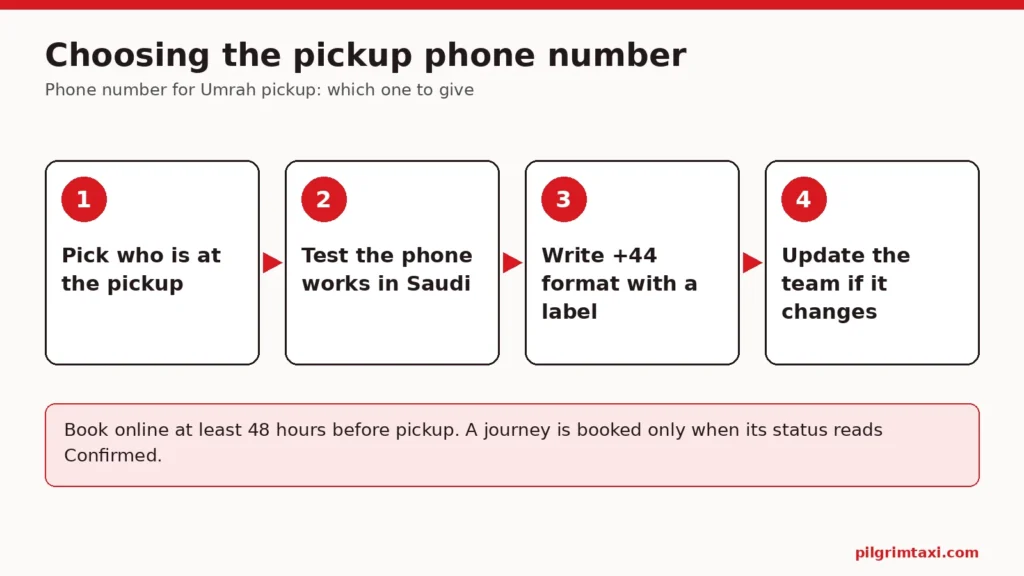
Why the number matters more than people think
On the day, the phone number is the link between a driver and a tired traveller. It is how a driver explains where they are waiting, and how the traveller says they are still at baggage reclaim. At hotels, where vehicles may stop is managed on the day and can change, so a quick call to agree a meeting point is often what makes the pickup work.
If the number is wrong, switched off, or belongs to someone thousands of miles away, that link is broken at exactly the moment it is needed. A correct booking with an unreachable contact can still go wrong.
Which phone number for Umrah pickup: the decision
The phone number for Umrah pickup should pass three tests:
- Presence. Will this person be physically with the travellers at the pickup?
- Reach. Will this phone work in Saudi Arabia on that day, for calls?
- Response. Will this person answer a call from an unfamiliar number, in a language they can manage?
The table shows how common choices score.
| Number | Present at pickup? | Works in Saudi Arabia? | Good as main contact? |
|---|---|---|---|
| Travelling adult’s UK mobile, roaming tested | Yes | Yes, if roaming is enabled and tested | Yes |
| Travelling adult’s Saudi SIM or eSIM | Yes | Yes, once activated | Yes, if activated before the pickup |
| Organiser’s UK mobile at home | No | Not relevant | No, second contact only |
| Elderly traveller’s basic phone | Yes | Only if roaming is enabled and tested | Only if they answer unknown calls confidently |
| Hotel reception number | No | Yes | No |
| Tour group leader’s number | Sometimes | Usually | Only if they will be at this pickup |
The best answer is usually a younger adult who is travelling with the party and uses their phone confidently. For an older traveller without a smartphone, our guide to an elderly pilgrim without a smartphone goes through the alternatives in detail.
A number for every journey, not only the airport
The airport pickup gets most of the attention, but a typical Umrah trip has several journeys: the arrival, perhaps the move between Makkah (Mecca) and Madinah (Medina), and the departure. Each one needs a contact who is present for that pickup.
The right number can change from journey to journey. The son who travelled with his parents on arrival may fly home first. A group may split between two hotels or two departure airports, and then each part of the group needs its own contact. Our guide to an Umrah group flying home from two airports shows how each departure gets its own lead traveller.
Before booking each journey, ask the same three questions again: who will be there, will the phone work, and will they answer.
Language on the phone
A pickup call is short and practical, but it still needs a shared language. We do not promise which languages a driver speaks, so it helps to plan for simple communication.
- Note in the booking the languages the main contact is comfortable with.
- If an older traveller will answer, write down in advance a few key phrases they can say: their name, “we are outside”, the number of bags.
- If a younger relative speaks better English or Arabic, make them the main contact even if an older relative is the lead traveller.
A short call in a shared language, followed by a live location, usually solves more than a long conversation.
Main contact and second contact
Give two numbers, each with a clear role.
- Main contact: the travelling person, as above.
- Second contact: the organiser at home, or a second travelling adult.
Give the main contact as the phone number at checkout. Put the second contact in the booking notes with a label, for example: “Second contact: Ayesha (organiser, in the UK) +44 7700 900123. Call only if Imran cannot be reached.”
The label does the work. A bare number in the notes leaves the reader guessing whose it is and when to use it. Our guide to one organiser and one travelling contact explains why these are two different jobs.
How to write the number
Write every number in full international format: a plus sign, the country code, then the number without the leading zero. A UK mobile written as 07700 900123 at home becomes +44 7700 900123 when written for someone abroad.
Common mistakes:
- leaving the leading 0 after the country code;
- writing the number with no country code at all;
- copying a number from an old trip or an old phone contact;
- mixing up two relatives’ numbers that differ by a digit.
Read the number back aloud before submitting, digit by digit. It takes ten seconds.
UK mobile roaming for Umrah: check before you fly
UK mobile roaming for Umrah is the simplest option if it works, because the traveller keeps their familiar number and nothing needs activating in Saudi Arabia. But it needs checking, not assuming.
Ofcom, the UK communications regulator, advises travellers to check their package or speak to their provider before going overseas to understand the charges and available packages. Its guidance also mentions setting a monthly bill cap, the automatic roaming message providers must send on arrival in another country unless you have opted out, turning off data roaming to limit costs, and using Wi-Fi where available.
Practical checks before the trip:
- Ask the provider whether roaming is available in Saudi Arabia on this plan, and whether it needs switching on.
- Ask what incoming and outgoing calls cost there. A pickup day may involve several calls.
- Check whether data roaming is included or charged separately.
- If you can, test that the phone rings when called from another country.
Some pay-as-you-go plans do not roam by default. Finding that out at home is far better than finding it out in the arrivals hall.
A Saudi SIM or eSIM
The alternative is a Saudi number. That changes which number the driver should call, so it needs careful handling.
In May 2025, the Communications, Space and Technology Commission announced that international pilgrims could request eSIM cards from local service providers through the providers’ applications, with digital activation through biometric verification in the Absher app, so that pilgrims are connected from the moment they arrive without visiting a branch. That route needs a compatible smartphone and the apps involved. Check the current process with the provider before relying on it.
The key problem with a Saudi number is timing. If the traveller will only have the new number after landing, it cannot go on the booking in advance. In that case:
- give the roaming UK number as the main contact for the airport pickup;
- once the Saudi number is working, send it to the booking team as an update, clearly linked to each booking it affects;
- use the Saudi number as the main contact for later journeys, such as hotel pickups.
Ofcom’s guidance also notes that a local SIM or eSIM may offer better rates than standard roaming. Whichever you choose, decide before travel which number is the airport contact.
WhatsApp number for the driver: what to know
Many families mainly use a messaging app, and it is natural to want to give a WhatsApp number for the driver. There are a few things to understand first.
A messaging app is not the same as a phone line. App calls and messages need mobile data or Wi-Fi. A phone with roaming for calls but data switched off may not receive app messages at all. An ordinary call on the mobile network is the dependable baseline.
The app stays linked to the number it was set up with. If a traveller buys a Saudi eSIM but their messaging app is still registered to their UK number, the app shows the UK number. Tell the booking team which number the app uses, not just which SIM is in the phone.
Do not assume the driver will use an app. We do not promise any particular messaging app. Say in the booking notes that the traveller also uses WhatsApp on a given number, if that is helpful, but make sure the main contact number can receive ordinary calls.
A clear note might read: “Main contact Imran +44 7700 900456, calls and WhatsApp. Roaming enabled and tested.”
Labelling home and travel numbers
When a family has several numbers in play, labels prevent confusion. Use role labels, not just names.
- “Travelling contact: Imran (son, travelling with parents)”
- “Organiser at home: Ayesha (daughter, UK)”
- “Traveller’s own phone: Abdul (father), calls only, speaks Urdu”
Keeping home and travel numbers clearly labelled matters because the label tells a reader what to do with the number, not just whose it is.
Keep the list short. Three well-labelled numbers are more useful than seven relatives’ numbers pasted into a note. Nobody knows who to call first when everyone is listed.
The email and the account are separate from the phone
The phone number is for the day of travel. The email address is where confirmations and status updates arrive, and the account is where the organiser follows the booking.
In the account area, the organiser can see the bookings, the status timeline, payment, any cash due to the driver, and the driver’s name once assigned. Payment secures a provisional request; the booking team updates the status within 1 to 12 hours, and the journey is booked only when it reads Confirmed.
Our note on choosing an email the organiser can actually use covers the email side. The phone number and the email do not have to belong to the same person, and often should not.
Updating a number after booking
Numbers change. A parent’s phone is replaced, a travelling son is swapped for a daughter, or a Saudi eSIM is activated.
To update a contact number:
- identify each booking the change affects, by reference;
- send the new number to the booking team with its role label, for example “new main contact for the airport pickup”;
- keep the acknowledgement;
- tell the travelling party which number is now the main contact.
Do not assume that changing a number on one booking changes it on all of them. For a trip with several journeys, check each one.
Contact changes are handled by the booking team. The online “Request a new pickup time” option in the account is for changing the time only, and an approved new time carries a £5 rescheduling fee, converted into the booking currency and paid in cash to the driver at pickup. A contact number update is not a time change. Use the contact page to reach the booking team.
When the organiser hands over
If a different relative takes over the planning before the trip, the numbers need to be handed over too. The new organiser should check every booking’s contacts against the current plan, not assume the old list is still right. Our note on a different relative taking over the planning covers the handover more broadly.
On the day: making the phone work
A few habits help the number do its job:
- Charge fully before leaving for the airport or hotel lobby, and carry a power bank and cable in hand luggage.
- Turn the phone on as soon as the aircraft rules allow after landing, and check roaming is active.
- Answer unknown numbers on pickup day. The driver’s number will not be in the contacts.
- Say where you are simply: which hall, which door, what you are wearing, how many bags.
- Send a live location if the driver asks. It is often clearer than a description.
The organiser at home can keep a copy of the key details: booking reference, pickup time in Saudi local time, the driver’s name once assigned, and every number with its label. Our note on an offline copy of the essential journey details shows what to keep.
If nobody answers
Sometimes a call does not connect: a phone is on silent, the battery has died, or roaming has not switched on. Agree in advance what each person does.
The traveller should stay where they are, somewhere sensible such as the arrivals hall or the hotel lobby, and try the main contact’s phone again once it is charged or connected to Wi-Fi. The organiser at home can check the account for the driver’s name once assigned and contact the booking team through the contact page.
Nobody should set off on foot looking for the car. Staying put and calling again is almost always quicker.
A worked example: the Hussain family’s numbers
Ayesha Hussain, in London, is booking transfers for her parents Abdul and Zubeda, who are travelling with her brother Imran.
The candidates. Abdul has a basic phone and rarely answers unknown numbers. Zubeda does not carry a phone. Imran has a smartphone on a UK contract. Ayesha is staying at home.
The decision. Imran is the main contact. Ayesha is the second contact. Abdul’s number goes in the notes as a third, labelled “calls only, Urdu speaker, unlikely to answer unknown numbers”.
The roaming check. Imran calls his provider. Roaming in Saudi Arabia is available on his plan but needs switching on; he switches it on and asks about call charges. He also plans to buy a Saudi eSIM through a provider’s app after landing, for data.
The booking. At checkout, Ayesha enters +44 7700 900456 as the contact and writes in the notes: “Main contact Imran (son, travelling) +44 7700 900456, calls and WhatsApp on this number. Second contact Ayesha (organiser, UK) +44 7700 900123. Abdul (father) +44 7700 900789, calls only.”
The update. On the second day, Imran’s eSIM is working. Ayesha sends the booking team the new number for the two remaining journeys, labelled “new main contact from the Makkah hotel pickup onwards”. Imran’s messaging app stays on his UK number, so Ayesha says so in the message.
The day. The driver calls Imran’s UK number on arrival. Imran answers, says they are at baggage reclaim with four cases, and sends a live location when they come out.
Checklist: the phone number for an Umrah pickup
- Choose a main contact who will be with the travellers at the pickup.
- Check that their phone will work in Saudi Arabia for calls, and test it if possible.
- Choose a second contact, usually the organiser, and label the role.
- Write every number in full international format with the country code.
- Put the main contact at checkout and the labelled second contact in the notes.
- Say which number any messaging app uses.
- Decide which number covers the airport pickup if a Saudi SIM or eSIM will be bought later.
- Send any new number to the booking team, linked to each booking it affects.
- Keep phones charged, turned on and answering unknown numbers on pickup day.
- Wait until each journey reads Confirmed before telling the family it is arranged.
With the contacts decided and labelled, open the Pilgrim Taxi ride finder and add the main contact at checkout exactly as written on your list.